
Introduction
The expression “the Gospel of the Grace of God” appears explicitly in the Apostle Paul’s farewell address to the Ephesian elders, where he summarizes the essence of his ministry as bearing witness to God’s unmerited favor toward sinners.1 This gospel proclaims that salvation is not attained by human effort, religious observance, or moral achievement, but is freely given through the redemptive work of Jesus Christ.
Though the doctrine of grace is most systematically articulated in the New Testament, particularly in the Pauline Epistles, it is neither novel nor detached from earlier revelation. Rather, it is the unfolding of God’s eternal redemptive purpose, progressively revealed throughout Scripture—from the Old Testament, through the incarnation of Christ, to the apostolic proclamation, and into the present age.
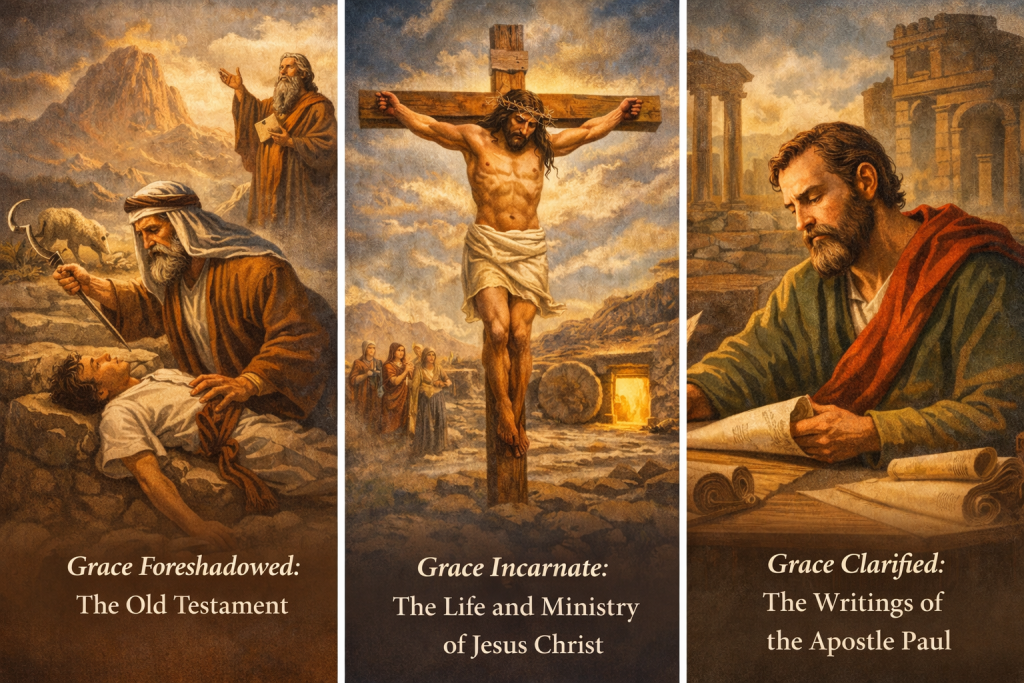
Grace Foreshadowed: The Gospel in the Old Testament
Contrary to the common assumption that the Old Testament represents a dispensation of strict legalism, the biblical record demonstrates that grace has always been central to God’s dealings with humanity.
Grace Before the Law
Immediately following humanity’s fall into sin, God announces a redemptive promise. In Genesis 3:15, often referred to as the protoevangelium, God foretells the defeat of the serpent through the seed of the woman.2 This promise reveals that redemption originates in God’s initiative rather than human repentance or reform.
God’s act of clothing Adam and Eve with garments of skin further illustrates substitutionary grace, as life is taken to cover human shame.3 This anticipates the later sacrificial system and ultimately the atoning work of Christ.
Justification by Faith in the Patriarchs
Abraham serves as the paradigmatic example of justification by faith. Scripture records that “he believed the LORD, and He counted it to him as righteousness” (Genesis 15:6).4 Significantly, this declaration occurs centuries before the giving of the Mosaic Law, establishing faith—not works—as the basis of righteousness.
The Apostle Paul later appeals to Abraham to demonstrate that justification has always been grounded in grace through faith, independent of works or ritual observance.5
The Law as Revelation, Not Redemption
The Mosaic Law was never intended as a means of salvation. Instead, it revealed God’s holiness and humanity’s sinfulness.6 The sacrificial system underscored the necessity of blood for atonement and the insufficiency of human obedience.7
The prophets looked beyond the Law to a future covenant in which sins would be forgiven definitively and God’s law internalized within the human heart.8
Grace Incarnate: The Gospel in the Life and Ministry of Jesus Christ
The Gospel of Grace reaches its fullest historical expression in the person and work of Jesus Christ.
The Incarnation as an Act of Grace
The incarnation itself is an unparalleled act of divine grace. “The Word became flesh and dwelt among us” (John 1:14).9 Christ entered history not as a judge enforcing the law, but as a Redeemer fulfilling it.10
John contrasts the Mosaic economy with the revelation brought by Christ: “For the law was given through Moses; grace and truth came through Jesus Christ” (John 1:17).11
Grace in Christ’s Teaching and Ministry
Throughout His earthly ministry, Jesus extended grace to those marginalized by religious legalism—tax collectors, sinners, and the ceremonially unclean.12 His parables consistently dismantle merit-based righteousness and exalt divine mercy, most notably in the parable of the Prodigal Son.13
The Cross: The Fulfillment of Grace
The crucifixion stands at the center of redemptive history. Christ bore the penalty of sin as a substitutionary sacrifice, satisfying divine justice while manifesting divine love.14 Justification is therefore grounded not in human obedience, but in Christ’s finished work.15
The resurrection vindicates Christ’s atoning work and confirms the sufficiency of grace for salvation.16
Grace Clarified: The Gospel Entrusted to the Apostle Paul
While all the apostles bore witness to Christ, the Apostle Paul was uniquely commissioned to articulate the doctrinal implications of the Gospel of Grace for both Jews and Gentiles.
Paul’s Apostolic Commission
Paul’s dramatic conversion underscores the nature of grace itself. Formerly a persecutor of the church, he was saved not through repentance initiated by the Law, but by sovereign revelation.17 He explicitly identifies his message as “the gospel of the grace of God.”1
Justification Apart from Works
Paul’s epistles present the most comprehensive explanation of justification by faith alone. “By works of the law no human being will be justified in His sight” (Romans 3:20).18 Instead, righteousness is credited apart from works through faith in Christ.19
Grace, by definition, excludes human boasting and secures salvation as a divine gift.20
Grace and the Christian Life
For Paul, grace is not merely the entry point into salvation but the governing principle of the Christian life. Believers are united with Christ, freed from condemnation, and empowered by the Holy Spirit to live in newness of life.21
Obedience is the fruit of grace, not its cause.22
Grace Proclaimed: The Gospel in the Present Age
The Gospel of the Grace of God remains the church’s central message in every generation.
A Timeless Message
In a world driven by performance, moralism, and self-justification, the gospel confronts both pride and despair. It declares full forgiveness for the guilty and complete sufficiency in Christ.23
The Church’s Responsibility
The church is called to preserve the purity of the gospel—neither adding legalistic requirements nor reducing grace to moral indifference.24 True grace transforms the believer, producing holiness rooted in gratitude rather than fear.25
Conclusion
From Eden to the present age, the Gospel of the Grace of God reveals a single, unified redemptive purpose. Promised in the Old Testament, incarnated in Christ, clarified through the Apostle Paul, and proclaimed today, this gospel declares that salvation is entirely the work of God.
Grace humbles the sinner, magnifies the Savior, and secures the believer. It remains the only hope of humanity and the everlasting good news entrusted to the church.
Scripture Footnotes
Romans 6:14; 1 John 2:3–6 ↩oughout Scripture—from the Old Testament, through the incarnation of Christ, to the apostolic proclamation, and into the present age.
Genesis 3:15 ↩
Genesis 3:21 ↩
Genesis 15:6 ↩
Romans 4:1–5; Galatians 3:6–9 ↩
Romans 3:19–20 ↩
Hebrews 9:22 ↩
Jeremiah 31:31–34; Ezekiel 36:26–27 ↩
John 1:14 ↩
Matthew 5:17 ↩
John 1:17 ↩
Luke 5:29–32 ↩
Luke 15:11–32 ↩
Isaiah 53:5–6; 2 Corinthians 5:21 ↩
Romans 3:24–26 ↩
Romans 4:25; 1 Corinthians 15:17 ↩
Galatians 1:13–16 ↩
Romans 3:20 ↩
Romans 4:4–8 ↩
Ephesians 2:8–9 ↩
Romans 8:1–11 ↩
Titus 2:11–14 ↩
Matthew 11:28–30; Romans 5:1 ↩
Galatians 1:6–9 ↩