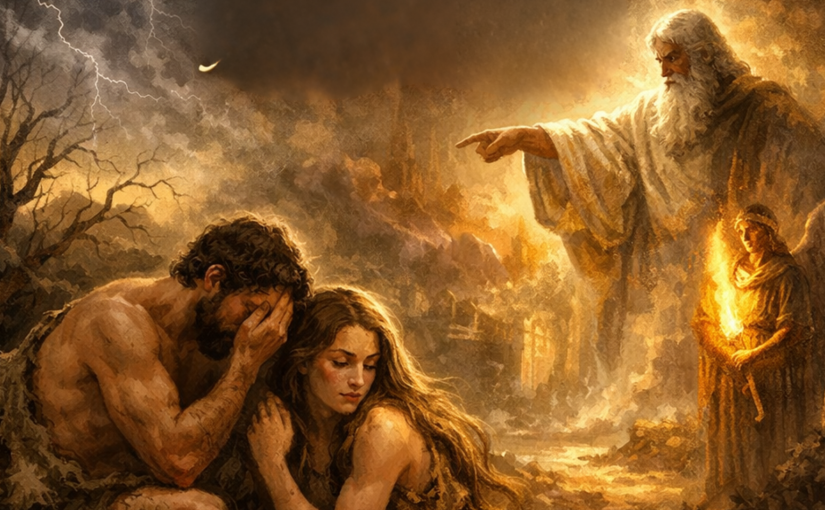
The First Promise of Redemption in Genesis After Adam’s Sin
Introduction: Grace Before the Echo of Judgment
The Gospel does not begin in Matthew, nor even in Isaiah—it begins in Genesis, in a garden ruined by sin yet visited by grace. When Adam fell, humanity did not merely stumble morally; it collapsed covenantally, spiritually, and representatively. Yet in the very chapter that records humanity’s greatest tragedy, Scripture also records God’s first redemptive promise. This is not accidental. It reveals the heart of God: judgment never has the final word where grace has been spoken.
Genesis 3 is therefore not merely the account of the Fall—it is the dawn of the Gospel.
Adam as Covenant Head and the Nature of the Fall
Adam was not merely the first man; he was the federal head of humanity. God entered into a covenant of life with Adam, often referred to as the Covenant of Works. Adam stood as humanity’s representative before God. His obedience would have meant life; his disobedience brought death—not only to himself but to all whom he represented.
When Adam sinned, several theological realities unfolded simultaneously:
- Legal Guilt – Adam stood condemned before God.
- Spiritual Death – Fellowship with God was broken.
- Moral Corruption – Human nature became inclined toward sin.
- Cosmic Disorder – Creation itself was subjected to futility (Romans 8:20).
This fall was total in scope but not absolute in destruction. Humanity was ruined—but not beyond redemption.
God’s Initiative: Grace Precedes Human Response
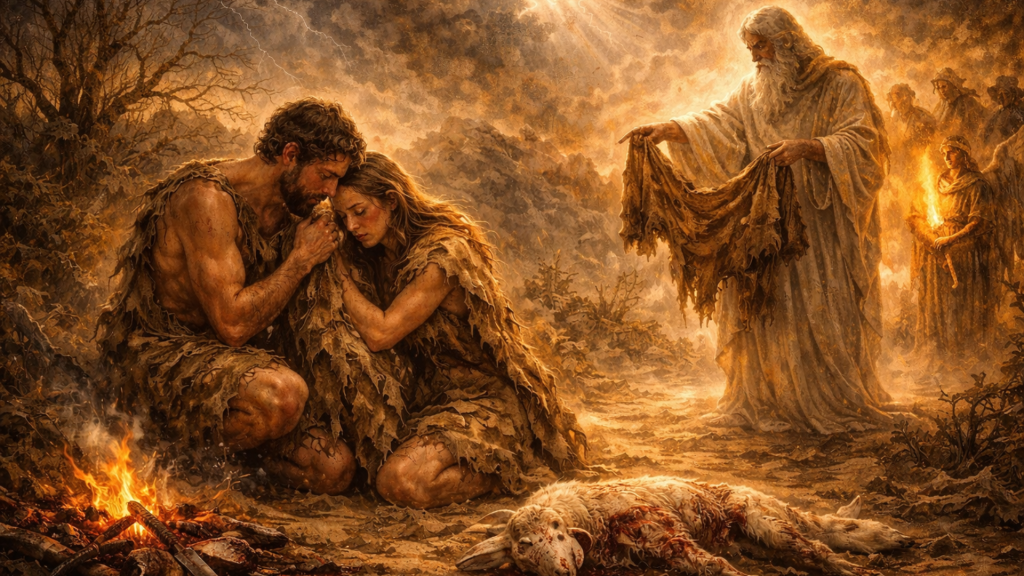
One of the most striking features of Genesis 3 is who speaks first after the fall. Adam does not cry out in repentance. Instead, he hides. It is God who seeks the sinner:
“But the LORD God called to the man and said to him, ‘Where are you?’” (Genesis 3:9)
This question is not for information but for invitation. It reveals a crucial Gospel pattern: God initiates redemption. Fallen humanity does not seek God by nature; God seeks fallen humanity by grace. This divine pursuit anticipates the later words of Christ: “The Son of Man came to seek and to save the lost” (Luke 19:10).
The Protoevangelium: The First Gospel Announcement

Genesis 3:15 stands as one of the most theologically significant verses in all of Scripture. Often called the Protoevangelium (“first Gospel”), it reads:
“I will put enmity between you and the woman,
and between your offspring and her offspring;
he shall bruise your head,
and you shall bruise his heel.”
This verse is rich with Gospel theology.
1. Divine Initiative in Redemption
God declares, “I will put enmity…” Redemption is God’s work from beginning to end. Fallen humanity naturally aligns with the serpent, but God sovereignly intervenes to create hostility between sin and grace.
2. The Promise of a Redeemer
The promise centers on a singular “offspring” (seed) of the woman. This is remarkable in a patriarchal context, subtly pointing forward to a virgin-born Savior. The New Testament confirms this fulfillment in Christ (Galatians 4:4).
3. Substitutionary Suffering and Victory
The serpent will bruise the heel—indicating suffering—but the offspring will crush the serpent’s head—indicating decisive victory. This is the theology of the cross in seed form: Christ is wounded to win. Satan’s apparent triumph at the cross becomes his ultimate defeat (Colossians 2:15).
Judgment and Mercy Interwoven
God’s curse upon the serpent, the woman, and the man is not arbitrary wrath—it is judicial judgment infused with redemptive purpose. Pain, toil, and death enter the human experience, but they also serve as reminders that this fallen world is not our final home.
Even expulsion from Eden is an act of mercy. God prevents humanity from eating from the Tree of Life in a fallen state, thereby sparing them from eternal life under condemnation. Redemption would come not through Eden regained by human effort, but through a Savior sent by divine grace.
The Covering of Sin: A Foreshadowing of Atonement
Genesis 3:21 provides a subtle but profound Gospel image:
“And the LORD God made for Adam and for his wife garments of skins and clothed them.”
This implies the first death in Scripture—an animal slain so that sinners might be covered. Adam and Eve’s fig leaves were insufficient; only God-provided covering could hide their shame. This anticipates the entire sacrificial system and ultimately the cross, where Christ’s righteousness clothes believers:
“For as many of you as were baptized into Christ have put on Christ.” (Galatians 3:27)
Adam and Christ: Two Representatives
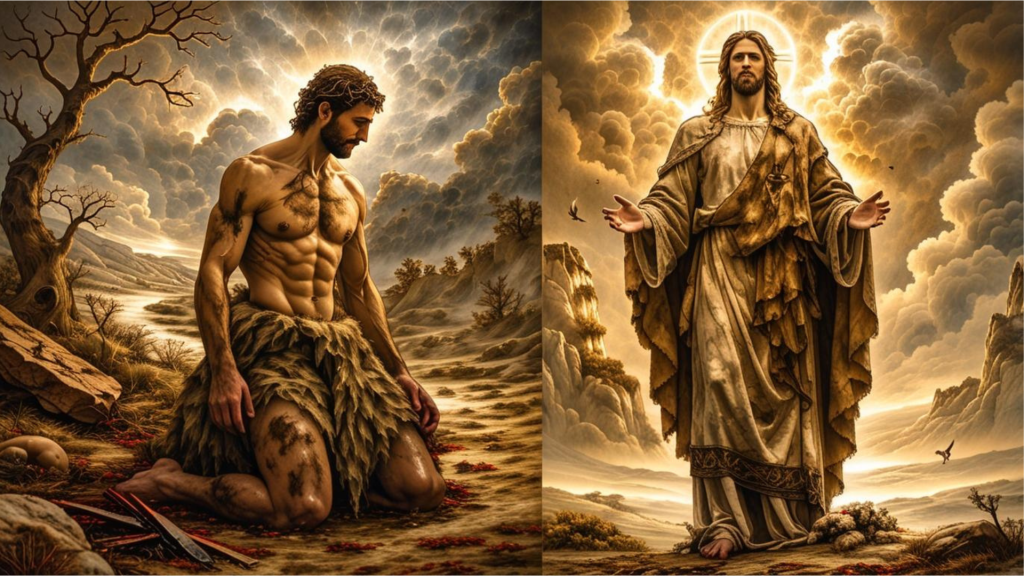
The Gospel promise in Genesis finds its full explanation in the New Testament’s contrast between Adam and Christ:
- Adam brought sin, condemnation, and death.
- Christ, the last Adam, brings righteousness, justification, and life (Romans 5:18–19; 1 Corinthians 15:22).
What Adam lost in Eden, Christ restores through obedience. Where Adam fell by a tree, Christ triumphs on a tree. Where Adam hid in shame, Christ stands exposed for sinners.
Theological Significance for the Church Today
The Gospel in Genesis teaches several enduring truths:
- Sin is serious – It brings death and separation from God.
- Grace is greater – God’s promise precedes human repentance.
- Redemption is Christ-centered – From Genesis to Revelation, Scripture points to Jesus.
- Hope is ancient and sure – The Gospel is not God’s backup plan; it is His eternal purpose.
Conclusion: From Garden to Cross to Glory
The story of Adam’s fall is not the end of hope—it is the beginning of redemption. In the very soil where sin took root, God planted the promise of salvation. The Gospel did not wait thousands of years to appear; it was spoken the moment humanity fell.
Genesis teaches us that even at our lowest point, God is already at work accomplishing His highest purpose. From Eden’s loss to Calvary’s victory, the message is clear: where sin abounded, grace abounded all the more.